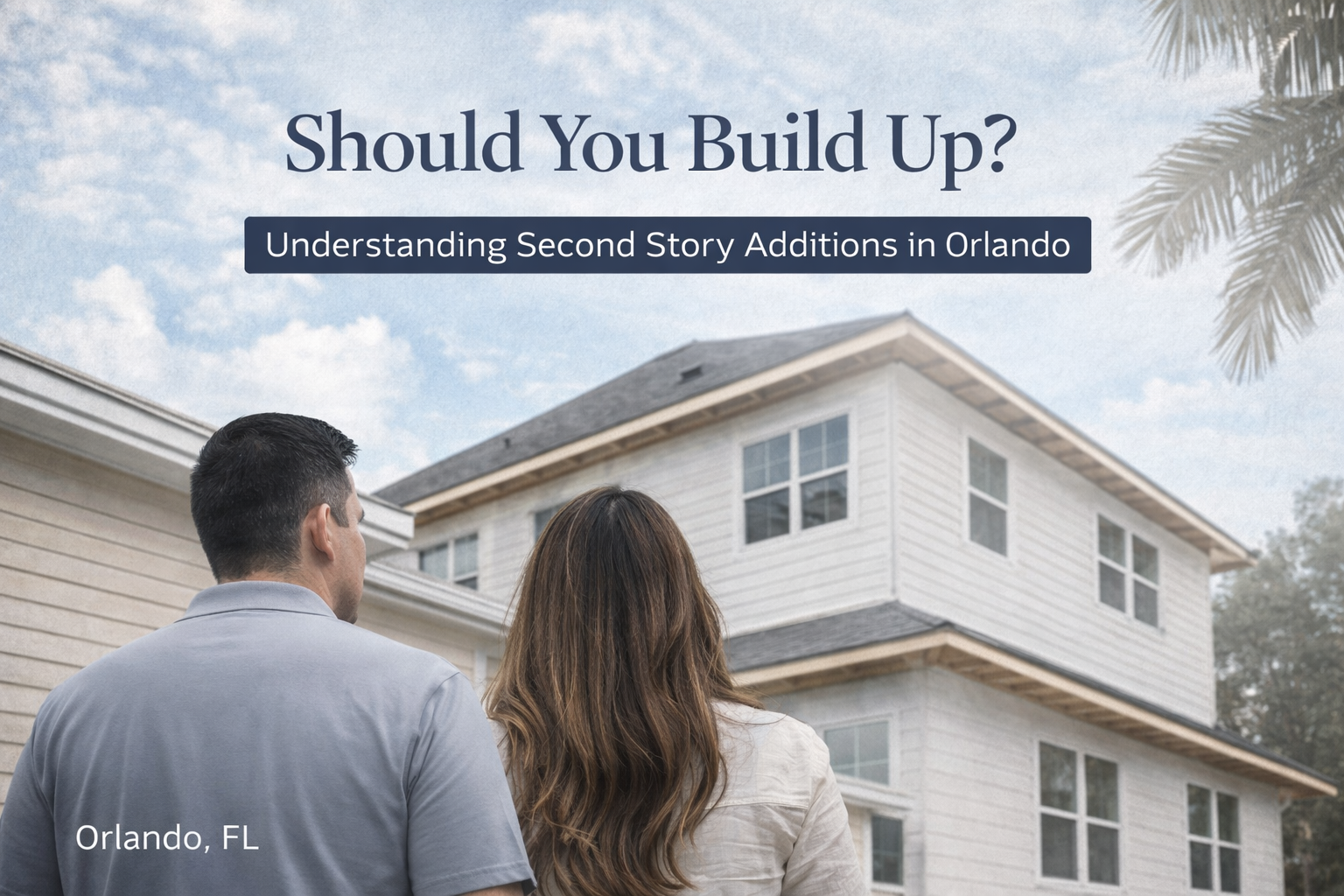

When a property has reached its maximum footprint and expanding outward is no longer an option, the only direction left to grow is vertical. A second story addition is one of the most significant residential construction projects a homeowner can undertake, and it is fundamentally different from other types of additions in both complexity and impact.
This is not an extension of an existing room or a bump-out that adds a few extra feet to a kitchen. This is the construction of an entire new level on top of a home that was originally designed and built to support only a single story. The structural, regulatory, and financial considerations that come with that decision deserve careful evaluation before any design work begins.
Why Orlando homeowners consider building up:
- Lot constraints make horizontal expansion impossible
- Setback requirements eliminate ground-level options
- Small lot size restricts outward growth
- High land values in established neighborhoods
- Deep roots in schools, commute, and community
For homeowners in Orlando and throughout Central Florida, the decision to build up rather than out is often driven by these lot constraints. But viability and suitability are not the same thing. Just because a second story is technically possible does not mean it is the right solution for every home or every homeowner. This guide walks through what makes a second story addition structurally feasible, financially sound, and worth the investment it requires.
Structural Feasibility: Can Your Home Support a Second Story?
The first and most critical question that has to be answered before any second story addition moves forward is whether the existing structure can support the additional load.
Here’s what most homeowners don’t realize: Most single-story homes in Central Florida were built with foundations and framing systems designed specifically for one level. Adding a second story places a vertical load on the foundation and framing that the original design never anticipated.
In many cases, the existing foundation can handle that load with reinforcement. In some cases, it cannot, and the scope of the structural work required changes the entire project equation.
What a structural evaluation covers:
Foundation assessment – Can the existing slab or foundation system carry the additional weight, or does it need underpinning and reinforcement?
Framing condition – Are the existing walls, beams, and load-bearing structures sound enough to support a second level?
Load-bearing wall configuration – Which walls carry weight, and can they handle vertical loads without modification?
Structural capacity – Can the home support not just the second floor structure, but also the furniture, occupants, and mechanical systems that will go into it?
A professional structural evaluation is not optional for second story additions. It is the starting point. If the evaluation reveals that the foundation needs underpinning, the framing needs significant reinforcement, or the existing walls need to be rebuilt to carry the load, those requirements have to be included in the project scope from the beginning. Discovering them halfway through design, or worse, during construction, is how projects that started with good intentions turn into serious problems.
The roof structure also factors into this evaluation. The existing roof has to be removed to build the second story, and the new roof that gets built on top of the addition has to tie into the original structure in a way that meets Florida’s building code requirements for wind resistance. In hurricane-prone regions like Central Florida, that means engineering the roof system to withstand the wind loads specified for the property’s wind zone designation.
Zoning and Height Restrictions in Orlando
Even when a home is structurally capable of supporting a second story, local zoning regulations determine whether a second story is legally permissible.
What you need to know about Orlando zoning:
Many residential zoning classifications in Orlando and Orange County have maximum height limits for single-family homes, and those limits vary by neighborhood and zoning district. A property zoned for two-story construction has a clear path forward. A property in a zoning district that limits structures to a single story or a specific height measured in feet does not, at least not without applying for a variance, which is a separate process with no guaranteed outcome.
The HOA layer: Homeowners in neighborhoods governed by homeowner associations face an additional layer of restrictions. Some HOAs prohibit second story additions entirely based on architectural guidelines intended to maintain neighborhood uniformity. Others allow them but require architectural review approval, which can involve:
- Detailed design submissions
- Neighbor notifications
- Extended approval timelines
- Specific architectural standards
These restrictions are not suggestions. They are enforceable covenants, and proceeding without HOA approval, even if the county has issued a building permit, can result in legal action and forced removal of unpermitted work.
The permit process for home additions in Orlando and Central Florida is detailed, and for second story additions, that process includes structural drawings, engineering calculations for the additional load, roof tie-in details, and compliance documentation for wind resistance and energy code requirements.
Bottom line: Homeowners who engage a builder with experience navigating this regulatory environment avoid the delays and revisions that come from submitting incomplete or non-compliant permit applications.
Cost Considerations: Why Second Story Additions Are Priced Differently
A second story addition involves construction elements that are fundamentally different from ground-level additions, and understanding those differences matters when evaluating whether this type of project fits within your planning.
What makes second story construction different:
Building vertically requires the removal of the existing roof, the installation of temporary weather protection during construction to prevent water intrusion into the first floor, the construction of floor framing and subflooring capable of carrying live loads, and the installation of new stairs that connect the two levels and meet code requirements for tread depth, riser height, and handrail specifications. Each of these elements represents work that a horizontal addition does not require.
Structural reinforcement adds another layer of complexity. If the foundation requires underpinning or the existing walls need to be reinforced with steel beams or additional framing, those are real construction requirements that have to be included in the project scope from the beginning.
Mechanical systems also become more complex:
- HVAC capacity must be evaluated for the additional square footage
- Zoned systems or secondary units may be required
- Electrical service often needs upgrades to handle increased load
- Plumbing for second-floor bathrooms requires vertical runs through the structure
Understanding what drives the cost of home additions in Orlando helps homeowners approach these projects with realistic expectations. For second story additions, the structural unknowns carry more weight than they do for other addition types.
The key takeaway: A homeowner planning a second story addition should budget with realistic contingencies for the structural work that may be required once the existing conditions are fully assessed. Projects that begin with budgets built only around the visible scope, framing, finishes, windows, consistently encounter challenges when the structural realities surface.
Living Through a Second Story Addition
One of the most underestimated aspects of a second story addition is what it is like to live in the home while it is being built.
Unlike a ground-level addition where the construction zone can sometimes be isolated from the main living areas, a second story addition involves work directly above occupied spaces.
What that means in practice:
- Noise and vibration from construction directly overhead
- Dust infiltration despite protective measures
- Construction crew presence throughout the work day
- Months-long disruption to daily routines
For families with young children, remote workers, or anyone with schedule sensitivities, this is not a minor inconvenience. It is a months-long reality that affects daily life in significant ways.
Weather protection and Florida’s climate: Temporary weather protection is installed during the roof removal phase to prevent rain from entering the home, but weather delays can still happen, and Florida’s afternoon thunderstorms are a predictable part of the construction environment. Builders experienced with second story additions in Central Florida schedule the roof removal and framing phases with weather patterns in mind, but no amount of planning can eliminate the inherent exposure that comes with opening up the top of an occupied home.
The relocation question: Some homeowners choose to temporarily relocate during the most disruptive phases of construction, typically the roof removal, framing, and weather protection stages. That decision adds temporary housing considerations to the planning process, but it can significantly reduce the stress and disruption for households that cannot easily adapt to an active construction environment.
Either approach works, but the decision should be made early in the planning process so that the timeline reflects the reality of how the household will manage the construction period.
When Building Up Makes Strategic Sense
A second story addition is the right solution for specific situations, and understanding whether your property and your circumstances align with those situations is part of the evaluation process.
You’re a strong candidate for a second story if:
- Your lot has setback requirements and coverage limits that eliminate horizontal expansion
- You’re in an established neighborhood where land values are high
- Comparable homes with more square footage command premium prices
- You’re deeply rooted in your location, schools, commute, and community
- Moving is not an appealing option despite needing more space
The decision also makes sense when the existing first-floor layout works well and does not require reconfiguration. A second story that adds bedrooms, a primary suite, or dedicated office space without disrupting the functional flow of the main level can deliver exactly the space a family needs without compromising the rest of the home.
Choosing a home addition over moving is often a sound decision when the realities of selling, buying, moving, and re-establishing in a new location are weighed against staying and expanding.
When second story additions are NOT the right fit:
- Homes with structural issues, foundation problems, or compromised framing
- Properties in zoning districts or HOA neighborhoods that restrict building height
- Homeowners whose budgets don’t account for the full scope of structural work, temporary protection, mechanical upgrades, and permitting
If you’re in that second category, exploring other options or delaying the project until you are better prepared is the responsible path forward.
The Role of Design-Build in Complex Addition Projects
Second story additions require a level of coordination and technical expertise that exceeds what most homeowners can manage on their own, and the fragmented approach of hiring a designer separately and then bidding the work to multiple contractors introduces risks that are difficult to manage once construction begins.
Why design-build matters for second story projects:
Design documents that do not account for the structural realities of the existing home lead to field changes. Field changes lead to project delays and scope adjustments. A design-build approach to home additions keeps the design and construction teams aligned from the beginning, which means structural concerns are addressed during design, not discovered during construction.
When the builder is involved in the project from the evaluation phase, the scope that gets designed reflects what is actually achievable within the constraints of the existing structure, the lot, and the budget. That alignment reduces the likelihood of surprises, keeps the project on schedule, and creates a single point of accountability for the homeowner throughout the process.
For projects as complex as second story additions, that accountability has real value. You can review how our construction process is structured to see what coordinated oversight looks like from the initial evaluation through final inspection.
Alternatives Worth Considering
Before committing to a second story addition, it is worth evaluating whether other options might deliver similar results with less complexity.
Ground-level addition – If the lot allows it, a well-designed ground-level addition may provide the square footage needed without the structural and regulatory challenges that vertical construction carries.
Garage conversion or ADU – For homeowners whose primary need is additional living space rather than additional bedrooms, converting an existing garage or building an accessory dwelling unit may be a more straightforward path.
New construction on the same lot – In some cases, particularly for older homes with significant deferred maintenance or outdated systems, new residential construction on the same lot delivers better long-term value than adding onto a structure that requires extensive work to bring to standard.
These alternatives are not right for every situation, but they deserve to be part of the conversation. A builder who only presents one option without evaluating the others is not giving the homeowner the full picture. The right decision depends on the specific conditions of the property, the homeowner’s long-term plans, and a realistic comparison of what each path delivers.
The Evaluation Comes First
The single most important step in planning a second story addition is the professional evaluation that happens before design work begins.
What a comprehensive evaluation includes:
- Structural engineer assessment of load capacity
- Builder evaluation of structural work requirements and construction sequencing
- Zoning review to confirm the project is permissible under local regulations and HOA covenants
That upfront investment in evaluation prevents expensive mistakes later and ensures that the project being designed is the project that can actually be built.
Homeowners who are seriously considering a second story addition should start with that evaluation, not with design ideas or budget estimates pulled from online sources. The conditions of your specific property determine what is possible, and those conditions can only be understood through a professional site assessment.
If you are at that stage, you can read what past clients have said about working through this evaluation process with our team on our testimonials page. When you are ready to move from research to a real conversation about your property, you can reach out to discuss your project and schedule a consultation at our Orlando office at 103 S Nashville Ave or at your home, whichever is more convenient for your schedule.