
One of the first questions homeowners ask when they start thinking about an accessory dwelling unit is what it actually costs. The honest answer is that it depends on more variables than most people expect, and any single number you read online without context is not a number you can plan around.
This guide breaks down what actually drives ADU costs in Orlando and what you need to know before you start getting quotes.
Why You Cannot Get a Real Number Without a Site Assessment
Two homeowners in Orlando can get ADU quotes that are tens of thousands of dollars apart and both quotes can be legitimate. The variables that drive cost are not minor. They include the type of ADU, the size, the condition of what already exists on the lot, what utilities need to be extended, the finish level, and current labor and material costs in Central Florida.
A garage conversion and a detached backyard cottage are both ADUs. They are not remotely similar in cost or complexity. Treating them as interchangeable when budgeting is how homeowners end up surprised mid-project.
Any contractor who gives you a firm number over the phone without seeing your property is not giving you a real quote. They are giving you a number low enough to keep you interested. The real cost comes out through change orders later.
The Type of ADU Is the Biggest Cost Variable
The single biggest driver of what your ADU will cost is what kind you are building. Each type has a fundamentally different scope of work.
A garage conversion works with what already exists. The foundation is there, walls are there, and the roof is there. The work involves adding insulation, finishing the interior, bringing in plumbing if it is not already present, upgrading electrical, and making the space livable to code. It is the least complex ADU path from a construction standpoint.
An attached ADU addition means building new square footage onto the existing home. You are constructing new walls, a new foundation section, a new roof section, and tying it into the existing structure. The complexity goes up significantly compared to a conversion.
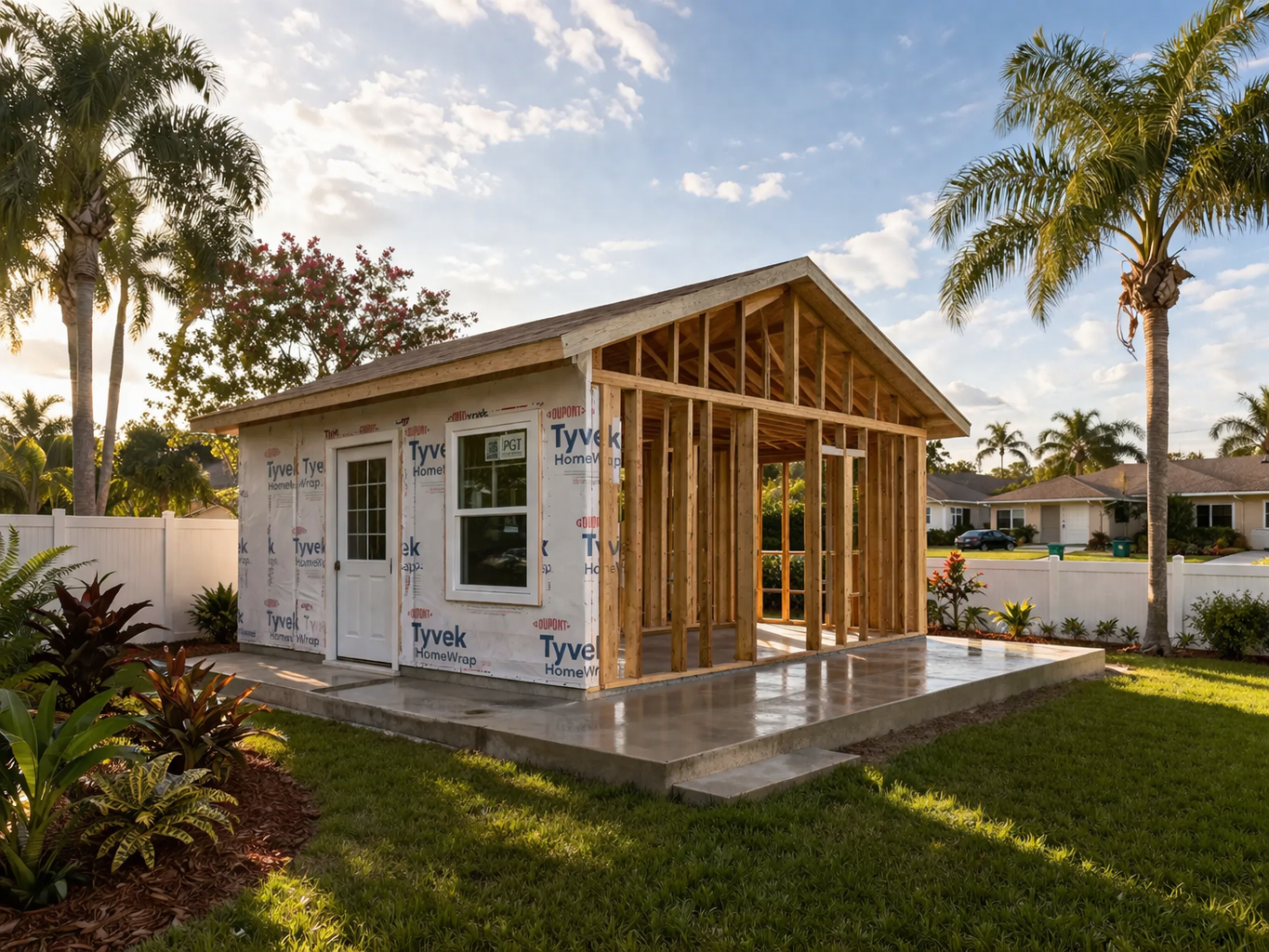
A detached ADU is a complete independent structure built from the ground up on the same lot. New foundation, full exterior, roof, and separate utility connections. It is the most involved scope of the three options.
If you are still deciding between detached and attached, the full breakdown of that decision is in the article on detached vs attached ADUs in Orlando.
What Drives the Cost of Any ADU Up
Beyond the type, several specific factors move ADU budgets significantly in the Orlando market.
Utility connections are one of the biggest variables most homeowners do not think about until a contractor brings it up. If a detached ADU needs a new water line, sewer connection, and electrical service run from the main home or the street, that is a significant cost on its own before any walls go up. Sites with existing utility access nearby cost meaningfully less to develop than those without.
Site conditions matter before anything else happens. A flat lot with easy equipment access is straightforward. A lot with drainage problems, poor soil, mature trees in the work zone, or difficult access adds cost and time that has nothing to do with the ADU itself.
Finish level affects everything from flooring and cabinetry to fixtures and appliances. A functional, well-built ADU with standard finishes costs less than the same footprint with high-end materials. Both are legitimate depending on what the unit is for.
Structural complexity is the variable most homeowners underestimate. If an attached ADU requires modifying load-bearing walls, reinforcing an existing foundation, or working around existing mechanical systems, the cost reflects that. This is exactly why a site assessment has to happen before any real number can be put on paper.
Soft Costs: What People Forget to Budget
The construction cost is not the total project cost. Soft costs are real and need to be in your budget from day one.
Permits through Orange County or the relevant municipality are required for any ADU regardless of type. Architectural drawings and structural engineering are required for permit submission. Impact fees may apply depending on your municipality. Landscaping, fencing, and site work after construction are often not included in a contractor’s base bid.
A contingency budget on top of everything else is not optional on a project of this scope. Structural surprises, utility complications, and permitting revisions happen. A budget with no room to absorb them creates problems that slow the project down and strain the relationship with your contractor.
Your contractor should walk you through every one of these line items before you sign anything. If they do not, ask. A vague total with no breakdown is not a real quote.
What to Ask a Contractor Before You Commit
Before you agree to any scope or sign any contract, there are specific things worth asking any ADU contractor in Orlando.
Ask them to walk you through every cost category separately, not just a single total. Construction, design and engineering, permits, utility work, and site work should each be a line item you can see and understand.
Ask what is explicitly excluded from their quote. What you think is included and what actually is included are often different things on a first quote.
Ask whether they have pulled ADU permits in Orange County or your specific municipality. The permitting process has specific requirements and a contractor who has been through it knows what to expect. One who has not will learn on your project.
Ask for references from completed ADU projects, not just general remodeling work. ADU construction has specific complexity that general remodeling experience does not automatically translate to.
The Right Starting Point
If you are serious about building an ADU on your Orlando property, the right first step is a proper site assessment by a licensed contractor who has built ADUs in the area. They need to see the lot, review your zoning classification, assess utility access, and understand what you want the unit to do before any real number can be given.
That conversation is also where you find out whether your lot can support the type of ADU you have in mind, which matters before you spend time planning around something that may not be possible given your setbacks and lot coverage limits.
If you are also considering a larger project scope beyond an ADU, the guide on home reconstruction in Orlando covers what that process looks like and how the two scopes compare from a permitting and planning standpoint.
At Magnet Remodeling we work on ADU projects across the Orlando area. Reach out through our services page to start with a proper assessment of your property.