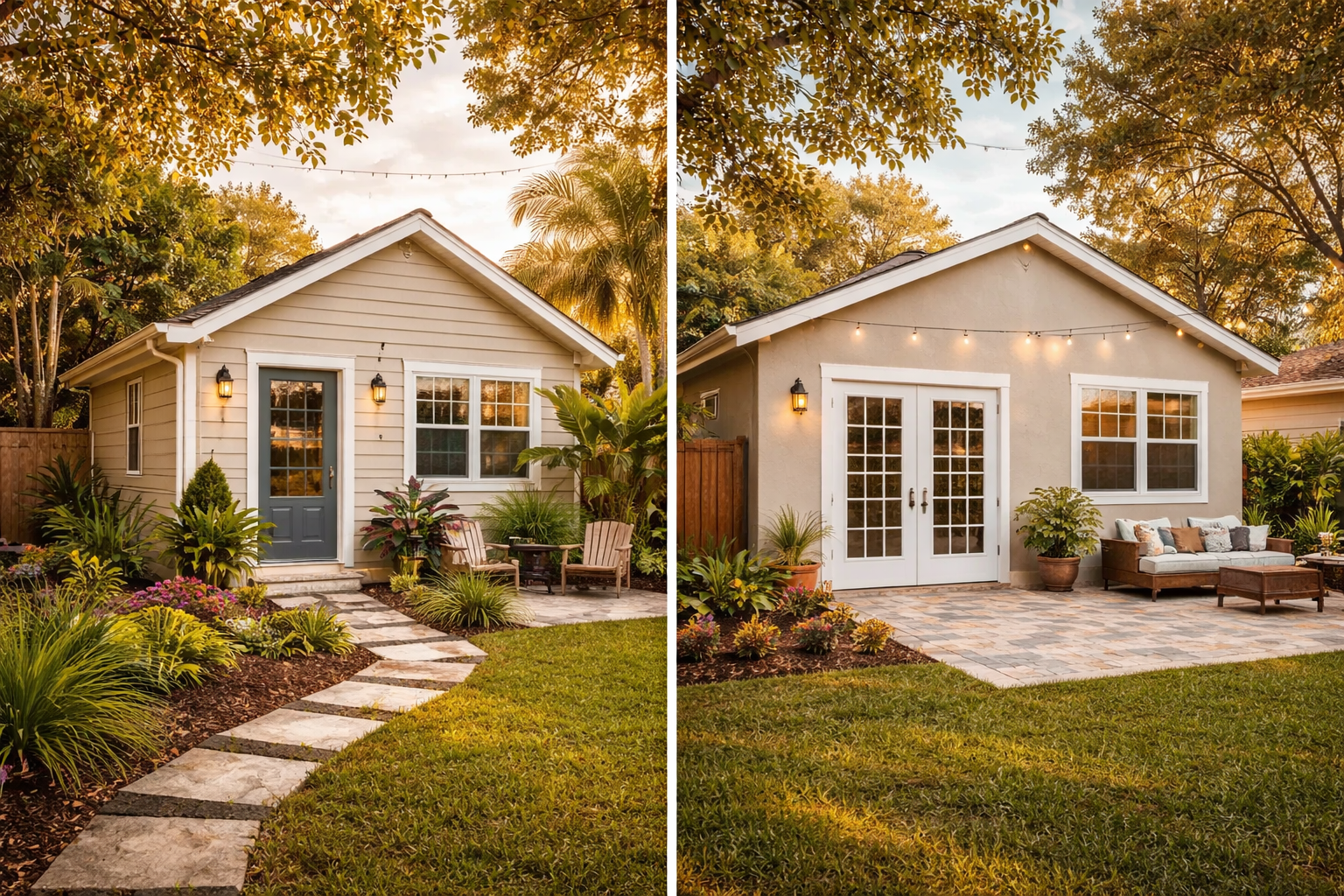

If you are planning to add an accessory dwelling unit to your Orlando property, the first real decision you have to make is not about finishes or square footage. It is whether to build detached or attached. That choice affects your budget, your permitting timeline, your lot requirements, and how the space actually functions once it is built.
This article breaks down both options so you can make the right call before you hire anyone.
What the Difference Actually Is
An attached ADU shares at least one wall with the primary home. It could be a converted garage, a basement apartment, an addition built onto the side of the house, or a unit above an attached garage. It is connected to the main structure in some way.
A detached ADU is a completely separate structure on the same lot. It has its own foundation, its own walls, its own roof. It does not touch the primary home. These are sometimes called backyard cottages or guest houses, though ADU is the correct term for permitting purposes in Florida.
Both are legal in Orlando under current zoning, and both qualify as ADUs for the purposes of permits, rental income, and property value. The question is which one makes sense for your specific situation.
How Your Lot Determines Your Options
Before you get attached to either option, your lot has to support it. Orlando and Orange County have setback requirements, lot coverage limits, and minimum lot size rules that will dictate what you can actually build.
For a detached ADU, you typically need more usable rear yard space. Orange County requires setbacks from the rear and side property lines, and the ADU footprint plus the existing home cannot exceed the lot coverage maximum for your zoning classification. If your lot is narrow or already has a large home footprint, a detached structure may simply not fit within the rules.
An attached ADU has more flexibility on smaller lots because it builds onto or into the existing structure rather than consuming additional ground coverage in the same way. A garage conversion, for example, does not add to your impervious surface at all.
This is the first conversation to have with a contractor before you commit to either path. A site assessment against your specific lot dimensions and zoning classification will tell you what is actually possible.
Cost Difference Between Detached and Attached
Detached ADUs cost more. That is the straightforward answer. You are building a complete independent structure from the ground up, which means a new foundation, a full exterior envelope, a separate roof, and independent utility connections.
In the Orlando market, a detached ADU typically runs between $150 and $250 per square foot depending on size, finishes, and site conditions. A 600 square foot detached unit can easily reach $120,000 to $150,000 or more before soft costs.
An attached ADU, particularly a garage conversion, costs considerably less because the foundation and at least one wall already exist. Garage conversions in Orlando typically run between $60,000 and $100,000 depending on the condition of the existing space and what systems need to be added. A full addition-style attached ADU will cost more than a conversion but still typically comes in below a fully detached build.
Neither of these is cheap. Anyone quoting you significantly below these ranges is either scoping less than you think or cutting corners you will pay for later. For a deeper look at what drives ADU costs in Orlando, the breakdown on our services page covers the main variables.
Privacy and Livability
This is where detached wins clearly for most homeowners. A completely separate structure means whoever is living in the ADU, whether that is a tenant, an aging parent, or an adult child, has genuine independence. There is no shared wall, no shared entrance, no sound traveling between units.
An attached ADU is more convenient to build and less expensive, but the shared wall is a real consideration. If the unit is for rental income, tenants in an attached ADU are closer to your living space than most homeowners anticipate before they build. Good soundproofing helps but does not fully solve it.
If the unit is for a family member who wants proximity but not full integration into the household, detached is usually the better fit. If it is purely for rental income and the lot does not support detached, an attached ADU with proper sound insulation is a reasonable solution.
Rental Income Potential
Both attached and detached ADUs can generate rental income in Orlando, and the market for ADU rentals in the area is strong. Orlando’s rental demand, driven by proximity to employment centers, universities, and the tourism economy, means a well-built ADU in a decent location will rent.
Detached ADUs generally command slightly higher rents because tenants place value on the privacy and independence of a separate structure. The premium varies by location and unit quality but is real.
The more important factor than attached versus detached is quality of build and quality of location. A well-finished attached ADU in a strong rental neighborhood will outperform a poorly finished detached unit every time.
Permitting: What to Expect for Each
Both types require permits through Orange County or the relevant municipality. Neither can be built without going through the process. Anyone suggesting otherwise is not someone you want on your project.
Detached ADUs require a full set of construction drawings, site plan review, zoning compliance verification, and inspections at multiple stages including foundation, framing, mechanical, and final. The process is comparable to building a small home from scratch.
Attached ADUs, particularly garage conversions, can move faster through permitting because the structural scope is typically less complex. That said, any attached ADU that adds living space, adds plumbing, or modifies the electrical system still requires permits and inspections. The permitting timeline in Orange County currently runs several weeks at minimum regardless of project type.
If you are also considering a larger home addition alongside an ADU, it is worth reading about home reconstruction in Orlando to understand how those scopes interact from a permitting standpoint.
Which One Should You Build?
If your lot supports it and your budget allows, detached is almost always the better long-term investment. The privacy, the rental premium, and the independence of a separate structure make it more functional and more valuable.
If your lot is constrained, your budget is tighter, or you are converting an existing garage, attached is a legitimate path and produces a real, permitted, functional ADU at lower cost and in less time.
The wrong answer is building either one without a proper site assessment first. Lot coverage, setbacks, utility capacity, and zoning classification all have to be verified before you commit to a scope. A contractor who quotes you without reviewing those variables is not giving you a real number.
Ready to Figure Out What Your Lot Can Support?
The team at Magnet Remodeling works on ADU projects across the Orlando area. If you want to know what your property can actually accommodate before you start planning, reach out here and we will walk through it with you.